

DATE: 18th October 2026
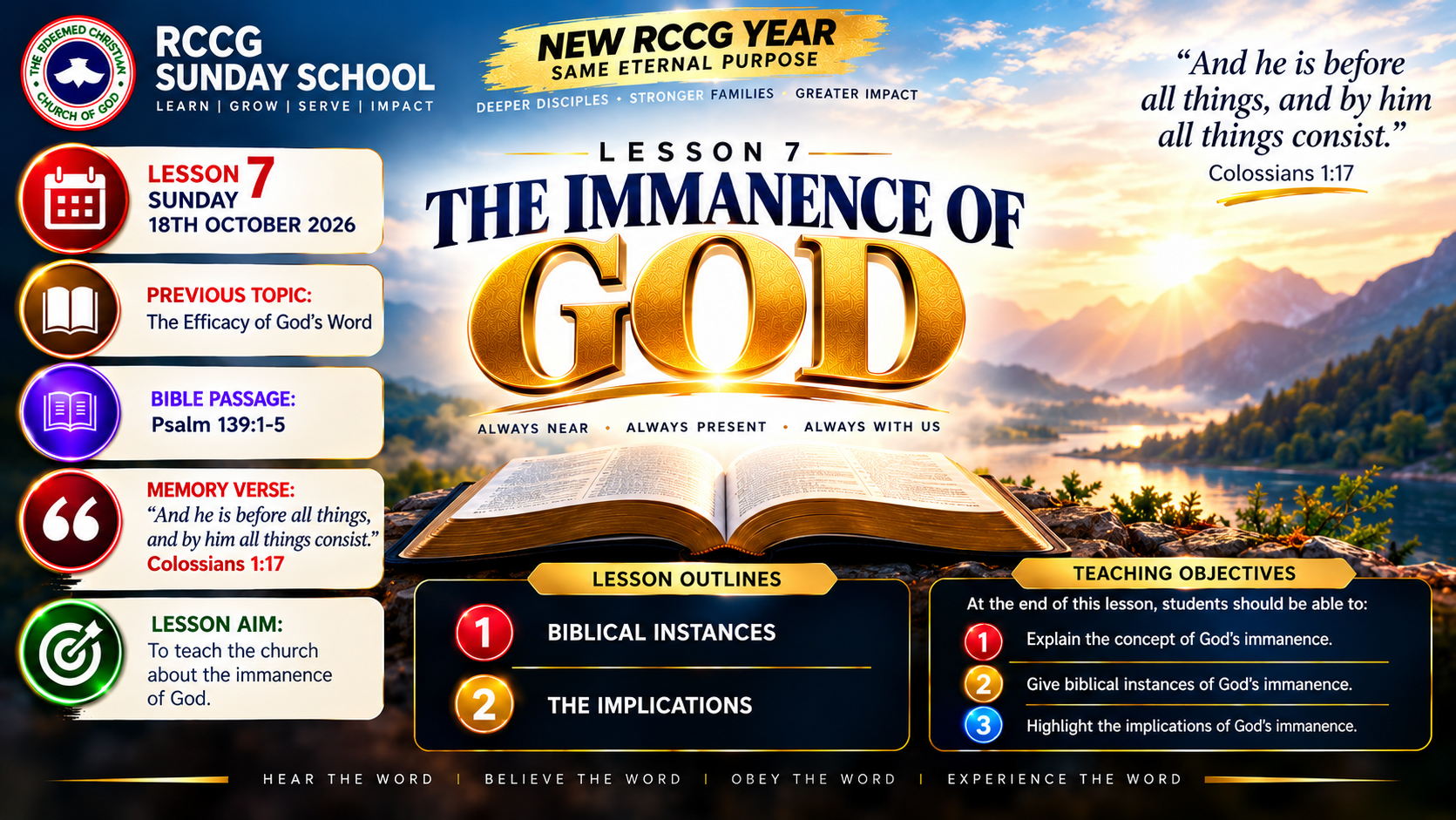
MEMORY VERSE: “And he is before all things, and by him all things consist.” (Colossians 1:17)
BIBLE PASSAGE: Psalm 139:1-5 (KJV)
O LORD, thou hast searched me, and known me. Thou knowest my downsitting and mine uprising, thou understandest my thought afar off. Thou compassest my path and my lying down, and art acquainted with all my ways. For there is not a word in my tongue, but, lo, O LORD, thou knowest it altogether. Thou hast beset me behind and before, and laid thine hand upon me.
I used the King James Version, since your memory verse matches it. Tell me if you’d like another translation.
The immanence of God refers to His presence, nearness, and active involvement in His creation and in the lives of His people. It is the biblical truth that God is not distant or merely observing from afar; He is close, attentive, connected and relational. This is different from His transcendence, which means that God is above, infinitely greater, more powerful, distant and separate from the material universe, existing beyond and utterly distinct from everything He created.
Jeremiah 23:23
Am I a God at hand, saith the LORD, and not a God afar off?
Isaiah 55:9
For as the heavens are higher than the earth, so are my ways higher than your ways, and my thoughts than your thoughts.
God has always been present with and involved in the world He created, especially with His people.
At creation, God formed Adam “from the dust” and breathed life into him. Genesis 2:7
And the LORD God formed man of the dust of the ground, and breathed into his nostrils the breath of life; and man became a living soul.
God’s voice was heard “walking in the garden.” Genesis 3:8
And they heard the voice of the LORD God walking in the garden in the cool of the day: and Adam and his wife hid themselves from the presence of the LORD God amongst the trees of the garden.
The burning bush reveals God’s personal call to Moses. Exodus 3:4
And when the LORD saw that he turned aside to see, God called unto him out of the midst of the bush, and said, Moses, Moses. And he said, Here am I.
…as well as His awareness, compassion, and active response to the affliction of His people. Exodus 3:7
And the LORD said, I have surely seen the affliction of my people which are in Egypt, and have heard their cry by reason of their taskmasters; for I know their sorrows;
God’s presence dwelt among Israel in the tabernacle. Exodus 25:8
And let them make me a sanctuary; that I may dwell among them.
His glory (visibly) filled the temple. 1 Kings 8:10-11
And it came to pass, when the priests were come out of the holy place, that the cloud filled the house of the LORD, so that the priests could not stand to minister because of the cloud: for the glory of the LORD had filled the house of the LORD.
David declares God’s inescapable nearness: whether in the heavens, depths, or darkness, God is there. Psalm 139:7
Whither shall I go from thy spirit? or whither shall I flee from thy presence?
1 Kings 19:12 reveals God’s personal and intimate way of speaking to His prophets.
And after the earthquake a fire; but the LORD was not in the fire: and after the fire a still small voice.
Jesus, becoming God in the flesh, is the ultimate act of divine immanence. John 1:14
And the Word was made flesh, and dwelt among us, (and we beheld his glory, the glory as of the only begotten of the Father,) full of grace and truth.
“Immanuel” means “God with us.” Matthew 1:23
Behold, a virgin shall be with child, and shall bring forth a son, and they shall call his name Emmanuel, which being interpreted is, God with us.
He came to the earth, walked, talked, healed, cried and ate with people.
Jesus promised that the Holy Spirit would come to dwell in believers. John 14:17
Even the Spirit of truth; whom the world cannot receive, because it seeth him not, neither knoweth him: but ye know him; for he dwelleth with you, and shall be in you.
The Spirit is not just near but indwelling, guiding, and teaching us. John 14:26
But the Comforter, which is the Holy Ghost, whom the Father will send in my name, he shall teach you all things, and bring all things to your remembrance, whatsoever I have said unto you.
Christ remains present with His people through the Holy Spirit. Matthew 28:20
Teaching them to observe all things whatsoever I have commanded you: and, lo, I am with you alway, even unto the end of the world. Amen.
In the New Heavens and New Earth, God will dwell fully and forever with His people. Revelation 21:3
And I heard a great voice out of heaven saying, Behold, the tabernacle of God is with men, and he will dwell with them, and they shall be his people, and God himself shall be with them, and be their God.
This is the eternal expression of God’s immanence. Thus, it is evidenced that throughout our earth’s sojourning till eternity the believer can enjoy God’s continual unbroken presence.
God is accessible. We can pray and hear from Him. 1 John 5:14-15
And this is the confidence that we have in him, that, if we ask any thing according to his will, he heareth us: and if we know that he heareth us, whatsoever we ask, we know that we have the petitions that we desired of him.
1. God is personal. God knows our thoughts, fears, and desires. Psalm 139:1-3
O LORD, thou hast searched me, and known me. Thou knowest my downsitting and mine uprising, thou understandest my thought afar off. Thou compassest my path and my lying down, and art acquainted with all my ways.
2. God is relational. You can relate and build intimate relationship with Him. 1 John 1:1
That which was from the beginning, which we have heard, which we have seen with our eyes, which we have looked upon, and our hands have handled, of the Word of life;
3. God is compassionate. He sees suffering and acts accordingly. Exodus 3:7-8
And the LORD said, I have surely seen the affliction of my people which are in Egypt, and have heard their cry by reason of their taskmasters; for I know their sorrows; and I am come down to deliver them out of the hand of the Egyptians, and to bring them up out of that land unto a good land and a large, unto a land flowing with milk and honey; unto the place of the Canaanites, and the Hittites, and the Amorites, and the Perizzites, and the Hivites, and the Jebusites.
Hebrews 4:15
For we have not an high priest which cannot be touched with the feeling of our infirmities; but was in all points tempted like as we are, yet without sin.
4. God disciplines and guides. As a Father does. Hebrews 12:6-7
For whom the Lord loveth he chasteneth, and scourgeth every son whom he receiveth. If ye endure chastening, God dealeth with you as with sons; for what son is he whom the father chasteneth not?
5. God is worthy of worship. Not just as Creator but as a loving Father. Revelation 15:4
Who shall not fear thee, O Lord, and glorify thy name? for thou only art holy: for all nations shall come and worship before thee; for thy judgments are made manifest.
6. He demands holiness, purity and high moral standard since He Himself is perfectly holy. 1 Peter 1:14-16
As obedient children, not fashioning yourselves according to the former lusts in your ignorance: but as he which hath called you is holy, so be ye holy in all manner of conversation; because it is written, Be ye holy; for I am holy.
God is not far from believers in Christ: “for in Him we live and move and have our being.” Acts 17:27-28
That they should seek the Lord, if haply they might feel after him, and find him, though he be not far from every one of us: for in him we live, and move, and have our being; as certain also of your own poets have said, For we are also his offspring.
His promise “I will never leave you nor forsake you” stands forever.
The outline gives no reference for this one. It is Hebrews 13:5, which you may want to add:
…for he hath said, I will never leave thee, nor forsake thee.
Notes: