

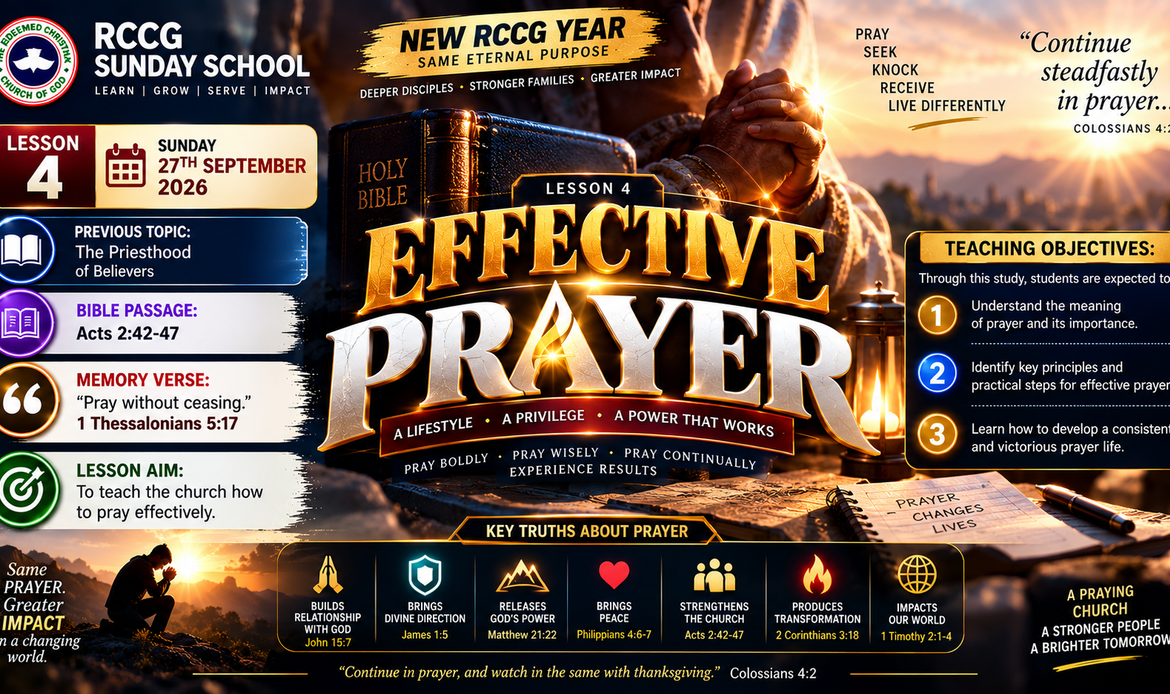
MEMORY VERSE:
‘The LORD is far from the wicked: but he heareth the prayer of the righteous.’’ Proverbs 15:29
BIBLE PASSAGE: James 5:16-18
INTRODUCTION
To be effective is to achieve a desired outcome. Prayer involves communicating with God, and effective prayer means conveying intentions clearly and receiving the anticipated response. Such prayer is powerful James 5:16b and aligns with God’s will Philippians 4:6; 1 John 5:14.
OUTLINES
THE ESSENTIALS AND OBSTACLES
Uprightness: According to Proverbs 15:8, prayers offered by individuals who demonstrate uprightness—characterised by salvation and righteousness—are considered pleasing to God.
God’s Word: Effective prayer incorporates the use of scriptural principles, as referenced in John 15:7.
Obedience: Adherence to divine guidance and acting on faith are identified as significant factors for effective prayer 1 Kings 17:8-14; Luke 17:11-14.
A Heart of Love: Prayers originating from a heart grounded in love are viewed as impactful Matthew 8:5-8, 13. Offering prayers for others is facilitated when motivated by genuine love Matthew 5:44-46.
Persistence: Consistently engaging in prayer and maintaining an appropriate relationship with God are indicated as essential components for achieving desired outcomes John 16:23-24.RCCG SUNDAY SCHOOL | 21
Potential obstacles to effective prayer include disobedience Proverbs 28:9, impure motives James 4:3, lack of faith or doubt Hebrews 11:6; James 1:6-7, and unwillingness to forgive Mark 11:25. Additionally, neglecting the needs of the disadvantaged can hinder the efficacy of one’s prayers Proverbs 21:13.
TYPES OF PRAYERS
Prayer of Faith: This form of prayer is characterised by strong conviction that God responds to the petitions of believers Mark 11:24. It is founded on the assertion of one’s rights and privileges in Christ John 14:12-14; James 5:15 and involves leveraging one’s understanding of God to achieve results through prayer Hebrews 11:6.
Prayer of Consecration: This prayer seeks to set aside an individual for a sacred purpose John 17:17-19. It entails presenting all aspects of oneself— mind, body, and will—to align with God’s plans Leviticus 20:7. Rather than a single occasion, this act should be ongoing, reflecting a sustained readiness to submit to God’s will, as exemplified by Jesus Luke 22:42. Believers are encouraged to offer themselves as living sacrifices Romans 12:1.
Prayer of Intercession: Intercessory prayer involves advocating for others to influence circumstances or outcomes Exodus 32:11-14. In His final prayer, Jesus petitioned for both His disciples and the unity of future believers John 17:18-21. The Holy Spirit supports believers by interceding when they lack the words to pray Romans 8:26-27. Hebrews 7:25 highlights Christ’s continual intercession for believers’ ultimate salvation.
CLASS ACTIVITY 1: Mention the most important key to effective prayer,
and why?
Prayer of Supplication: Supplication refers to making requests or seeking assistance from God, rather than asserting demands Philippians 4:6- 7. Believers are invited to approach God’s throne confidently to receive mercy and support in challenging times Hebrews 4:16. Supplication forms a crucial element of Christian spiritual life Ephesians 6:18 and should be accompanied by thanksgiving Philippians 4:6. Requests may be made on behalf of oneself Philippians 4:6, other Christians James 5:16), individuals in authority, and those who have not yet embraced faith 1 Timothy 2:1-4.
CLASS ACTIVITY 2: How does each of the different kinds of prayer
strengthen a believer’s relationship with God?
CONCLUSION
You too can pray and get results.
FURTHER READINGS: Sun: Mark 11:24. Mon: Philippians 4:6. Tue: 1 John 5:14. Wed: 2 Chronicles 7:14. Thurs: James 5:16. Fri: 1 John 1:9. Sat: Hebrews 4:16.
WORKBOOK ACTIVITIES / QUESTIONS